Beauty standards, men, and medication
Noticed: 28 May 2026
Location: Goodge Street Station
health and wellbeing
health and wellbeing
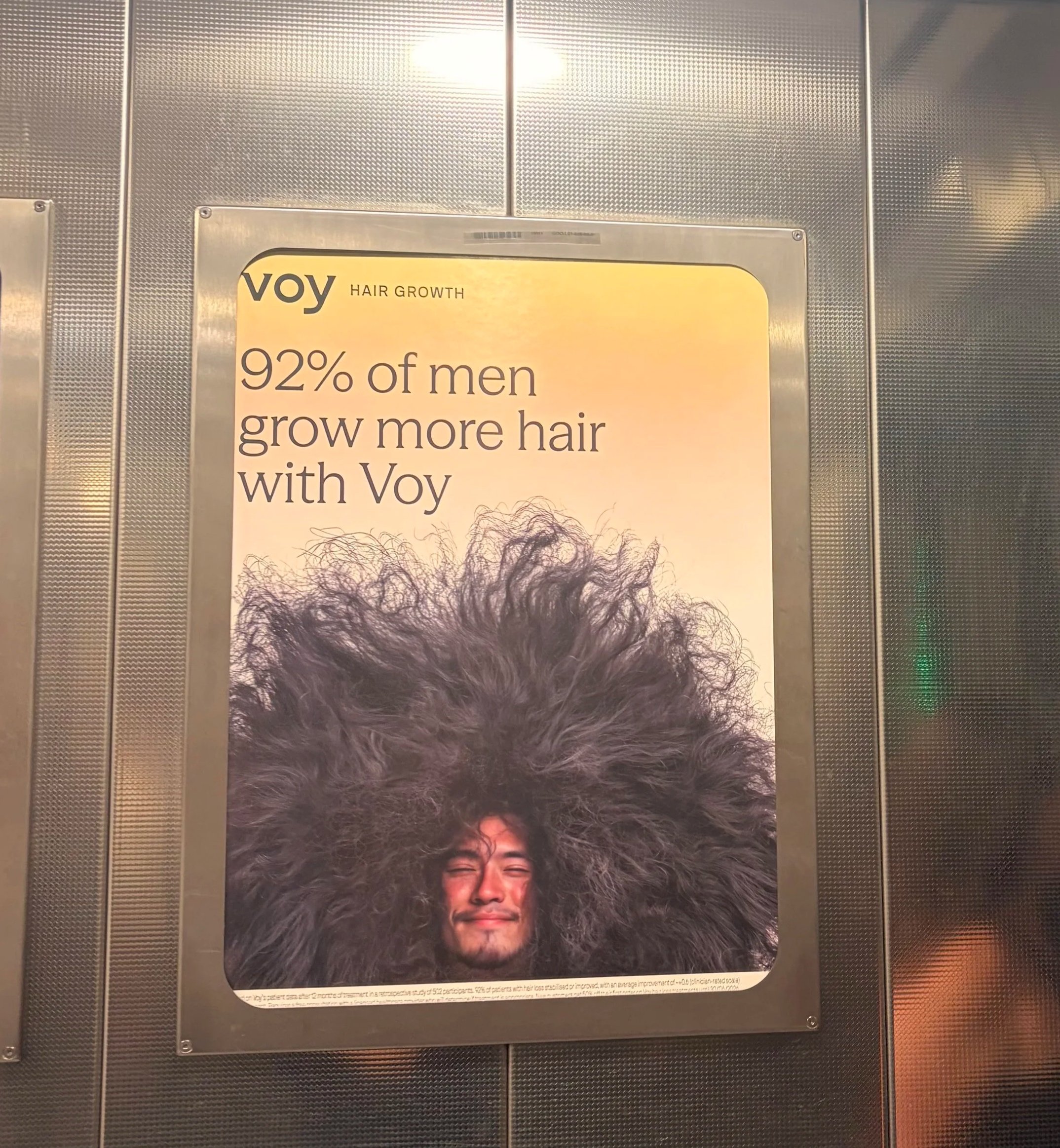
This advertisement is one of the first examples I have seen of a beauty standard enforced upon men so directly.
Voy is a UK-based digital health care company that offers a variety of services that includes prescription treatments for hair loss. This is a fairly new campaign, which I find to be modern, irreverent, and clearly aimed at young men.
The focal image is a man with an obviously exaggerated, supernatural mane, underneath the tagline – ‘92% of men grow more hair with Voy.’ Whether these results were in the nanometres and or in a controlled group of about 5 people, who cares. My question is when male hairlines became enough of an issue that such drugs have been developed and marketed for mass consumption.
With any of the advertisements I photograph, I find the fact that they are on such coveted advertising space, England’s most concentrated and populous transport network, means they are likely to be very well placed in whoever they are, and whatever they are selling.
An advertisement that speaks specifically to men, and says it is offering a highly effective treatment to grow more hair, makes me ask what part of our culture it is responding to.
If we look at what we can prove, the International Society of Hair Restoration Surgery (ISHRS) claims people are getting more hair transplants than ever, with approximately a million global treatments taking place per year. Interest in the drugs, has spiked in recent years too, where between 2020 and 2025, search engines reported an 88% increase in searches of Finasteride, one of Voy’s key ingredients.
What’s changed? Has society turned up the pressure to have a good hairline? Or similarly to GLP-1s, has science just finally produced a solution that avoids going under the knife?
I think both can be true.
Voy is certainly responding to something. And the reason I find this to be another moment in time culturally, is because it is startlingly similar to advertising that has targeted women’s beauty standards for decades.
If we follow the story, it seems an idealisation exists, in this case a bad hairline, in another case, wrinkles, small breasts, thin lips, (I won’t go on). There is an effective cosmetic solution, that maybe you saw an influencer admit to having online. It is expensive, painful, and feels like a last resort. Then in a year or five, the beauty industry churns out the at-home alternative.
It is worth watching how these are presented as your lighter, less risky solution for a defect that never had to be a defect in the first place. While Voy may position itself as innocently helping, these campaigns do create additional pressure. They can disguise themselves as optimisers, or even forms of healthcare, but that doesn’t subtract from the very core message: you can make yourself look better with us.
Thank you?
When it comes to aesthetic advertising, don’t forget that whether you should undertake treatment, or care that much about the latest part of human attractiveness that is ravaging society.
We must not forget to scrutinise the beauty industry for profiting from our vulnerabilities. And the more we see these ‘solutions’ for new ‘problems’, the more insecurities we are convinced to have. Ripening society for exploitation.