
neurodivergence is having its moment
Noticed: 21 June 2026
Location: Northern Line, TFL
health and wellbeing
health and wellbeing
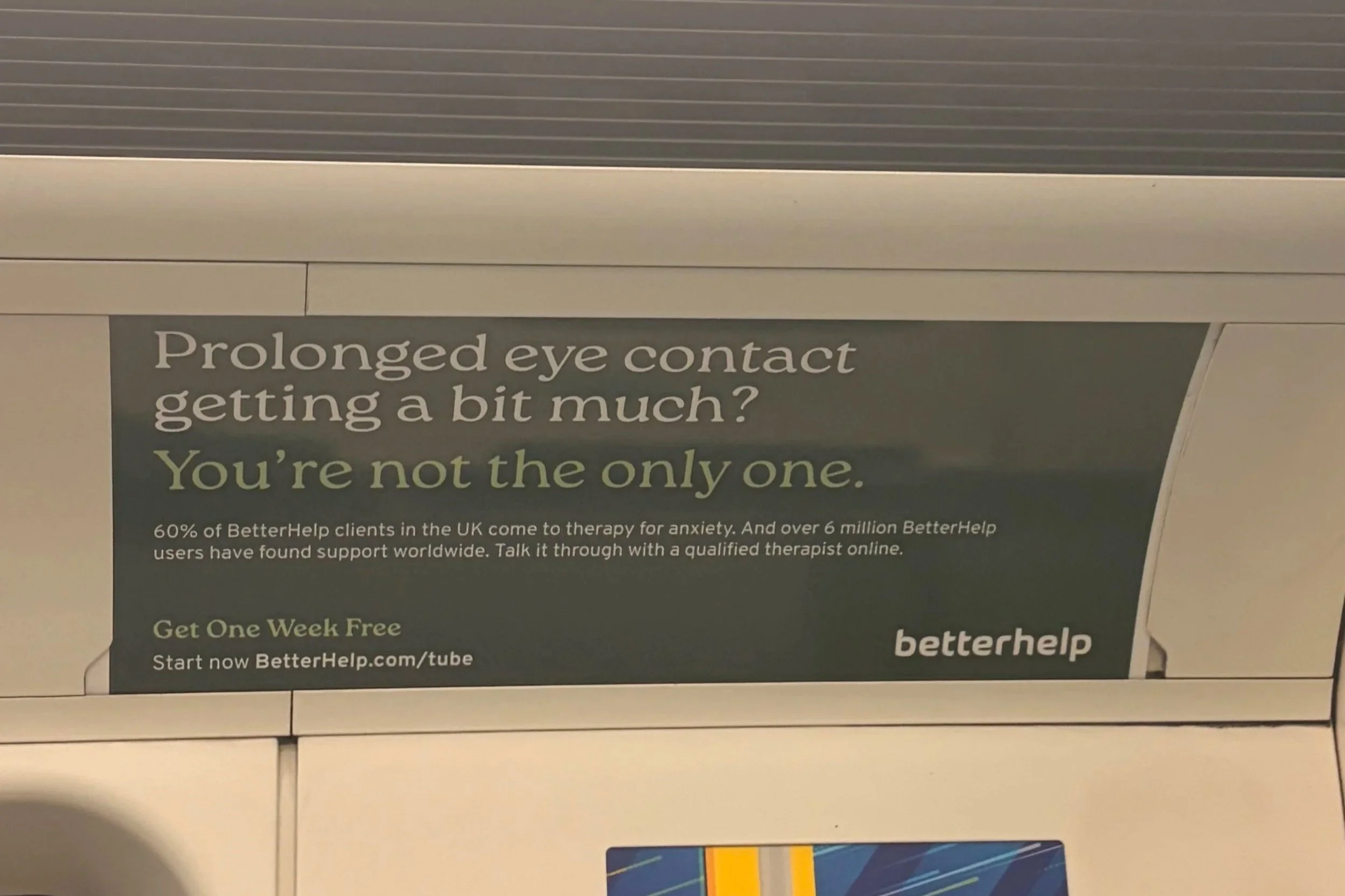
Better Help are an online-based mental health platform. Distinguished for providing affordability, they are a less expensive route than most conventional forms of private therapy in the UK.
For one thing, I’d like to celebrate how the service’s advertisement on the tube feels pretty normal today. In the 2010s, the stigma surrounding mental health certainly took a beating, and awareness has skyrocketed since before the pandemic. Aided by social media, taking your mental health seriously is not as contrarian as it used to be.
But I think this advert is doing more than that. It may be signalling that we have reached another stage in the public conversation, and it’s all about neurodiversity.
‘Prolonged eye contact getting a bit much? You’re not the only one.’
Difficulties with eye contact, is strongly associated with Attention Deficit Hyperactivity Disorder (ADHD) and Autistic Spectrum Disorder (ASD). Both hot topics currently, these disorders are being understood as far greater than social awkwardness, but variations in brain function. When you zoom out, that description is as broad as the range of behaviours and symptoms people feel, but brain function is quite literally how people keep themselves alive, socialise, feel, think; experience the world.
And it feels as though neurodivergence is finally becoming understood culturally, as much richer than bizarre classroom behaviours.
The problem with eye contact, is that the eyes and face contain a huge amount of visual stimuli. People with ASD and ADHD often struggle to interpret all stimuli in different orders and/or intensities to someone neurotypical. Lights can be brighter, noises feel louder, and the messages from somebody’s facial expression can arrive during one of those frequent moments of disorientation.
Yet eye gaze and body language are the moderators of a lot of social interactions, and have become entangled with manners and etiquette in cultures like Great Britain.
10+ years ago, would we see anything on the tube that says it’s okay to not look people in the eye? And you can access some therapy for it?
But today, the picture is very different. Between 2020 and 2024, job postings on Indeed that include neurodivergent accommodations grew 6-fold. And today, the CIPD estimates that around 20% of people may be neurodivergent.
That goes beyond better scientific research. That is a loosening of cultural parametres. So what has changed?
I would not reduce it to coincidence that neurodivergent awareness has absolutely boomed on social media. Without proving anything, creators and users have collaboratively normalised the topic with each other, enough to prompt organisations like BetterHelp to speak to it directly.
These stopped being odd topics hushed out of public dialogue a while ago. But this nod to one of the major struggles of neurodivergent life, suggests that we are delving even deeper into helping people.
It may have progressed from: if you suffer with poor mental health then you should have support and not be embarrassed.
We seem to be getting more specific about why people may feel anxiety, what it is about socialising or working or existing that is genuinely difficult.
I hope to see more media that pays attention like this.
Related Sources